


How to Export Rice From India to Canada?
Exporting rice internationally is one of the most scalable agribusiness opportunities today, especially for suppliers who understand compliance, logistics, and buyer expectations. Canada has emerged as a high-potential destination for Indian rice exporters due to its multicultural population, premium grain demand, and strong retail distribution network. Importers consistently seek high-quality basmati and specialty varieties, creating steady demand for reliable suppliers.
For businesses planning global expansion, entering the Canadian market can be a strategic move because it offers stable pricing, transparent import policies, and long-term contracts. Further, this guide explains the entire export process in a practical format, from registration and documentation to costs, logistics, and buyer acquisition, so you can build a sustainable rice export business.
Why Canada Is a Profitable Market for Indian Rice Exporters?
Canada’s rice consumption is steadily rising due to immigration growth, restaurant demand, and the popularity of international cuisines. Indian rice varieties, especially premium basmati, are widely used in households and food service industries. Compared to many markets, Canada offers:
- Predictable import regulations
- High purchasing power
- Preference for premium grains
- Strong demand from ethnic supermarkets
Exporters already supplying markets such as export rice from India to UK or export rice from India to USA often find Canada easier to scale because of transparent trade standards and structured distribution channels.
Types of Indian Rice in Demand in Canada
Understanding buyer preference is essential before exporting. Canadian importers typically request:
1. Basmati Rice
The highest-demand category, known for aroma and long grains. Premium variants from the types of 1121 basmati rice segment often fetch higher margins.
2. Non-Basmati White Rice
Widely used in restaurants and food processing.
3. Sona Masoori
Popular among health-conscious consumers because of its light texture.
4. Organic Rice
Growing niche segment with higher profit potential.
If you’re new to exports, learning about the different types of rice in India helps you match product quality with buyer expectations.
Mandatory Registrations Required to Export Rice
IEC Code (Import Export Code)
Issued by DGFT, this is mandatory for all exporters.
FSSAI License
Required for food product export businesses.
GST Registration
Needed for tax compliance and invoicing.
APEDA Registration
Registration with APEDA is compulsory for exporting agricultural commodities, including rice.
Without these approvals, customs clearance and international shipments cannot proceed.
Documents Required for Rice Export Shipment
Documentation accuracy is critical because even minor errors can delay shipments or cause rejection. Standard export documents include:
- Commercial invoice
- Packing list
- Certificate of origin
- Phytosanitary certificate
- Bill of lading
- Fumigation certificate
Professional exporters maintain a digital checklist to ensure every shipment file is complete before dispatch.
Canadian Import Rules You Must Follow
Every country has its own food safety standards. In Canada, rice imports must comply with regulations monitored by the Canada Border Services Agency and food inspection authorities.
Key requirements:
- Accurate product labeling
- Ingredient declaration
- Packaging weight standards
- Pesticide residue limits
- Traceability details
Non-compliance can result in shipment rejection or penalties, so exporters must confirm importer-specific requirements before dispatch.
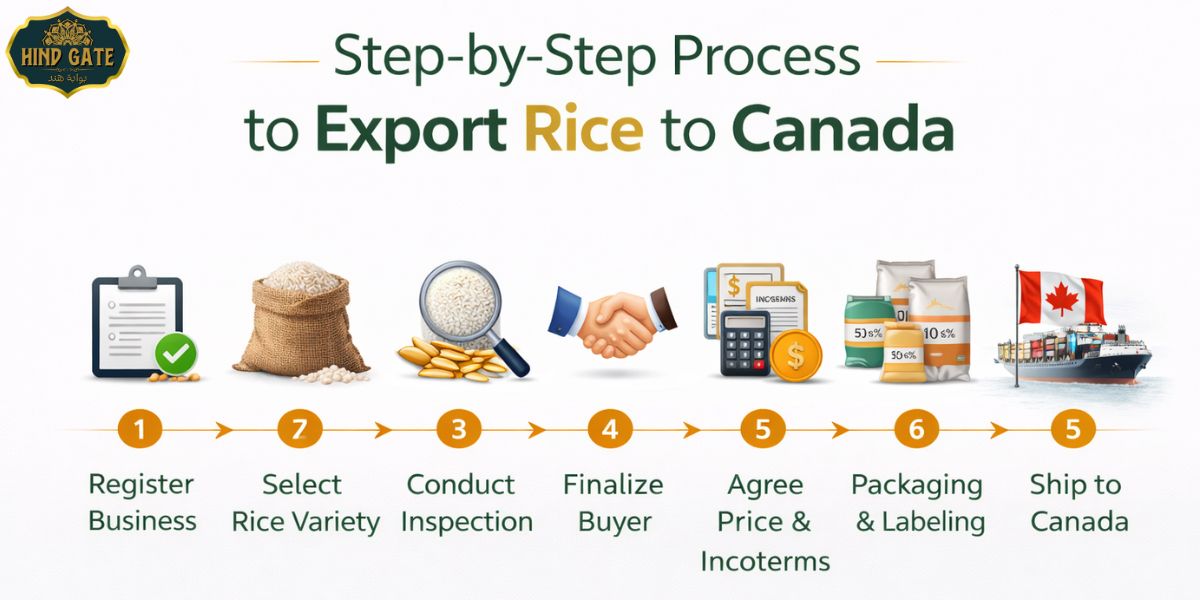
Step-by-Step Process to Export Rice to Canada
This simplified workflow helps beginners understand the export journey:
- Register your export business: Obtain IEC code, GST, FSSAI license, and APEDA registration to legally export rice.
- Choose the right rice variety: Select basmati or non-basmati based on Canadian buyer demand and market trends.
- Check quality and grading: Ensure rice meets export standards for grain length, purity, and moisture level.
- Find a buyer and agree on price: Negotiate quantity, rate, packaging type, and delivery terms.
- Confirm payment terms: Finalize LC, advance payment, or bank transfer and decide incoterms (FOB, CIF, etc.).
- Pack and label shipment: Use export-grade packaging with proper labeling and compliance details.
- Clear customs documentation: Prepare invoice, packing list, certificates, and shipping bill.
- Ship the cargo: Ship via sea freight (bulk) or air freight (samples/urgent orders).
- Result: Following these steps reduces risk, prevents delays, and builds trust with international buyers.
Cost Breakdown for Exporting Rice to Canada
Export cost depends on rice type, packaging, and shipping method. Typical cost components include:
| Cost Component | Description |
|---|---|
| Rice price | Mill or supplier cost |
| Processing | Cleaning, grading, polishing |
| Packaging | Bags, branding, labeling |
| Transport | Inland freight to port |
| Shipping | Sea freight charges |
| Insurance | Cargo protection |
Exporters who calculate these costs accurately can price competitively while maintaining profit margins.
Profit Margin Example
Suppose you export 20 tons of premium basmati:
- Purchase cost per ton: $900
- Logistics + packaging: $150
- Total cost: $1050
If selling price is $1250 per ton, profit equals $200 per ton. For a full container, that becomes a significant margin. Efficient logistics and direct buyers can further increase profitability.
Packaging Standards for International Rice Export
Packaging quality directly affects buyer trust. Canadian importers generally prefer:
- Moisture-proof bags
- Food-grade material
- Strong stitching
- Clear labeling
Common packaging sizes:
- 5 kg retail packs
- 10 kg household packs
- 25 kg wholesale bags
Branded packaging helps establish long-term recognition in overseas markets.
Shipping Methods and Transit Time
Exporters can ship rice via:
Sea Freight
Most economical option for bulk shipments. Transit time ranges from 25 to 40 days, depending on port routes.
Air Freight
Used for samples or urgent orders. More expensive but faster.
Sea freight is recommended for large orders because it reduces per-unit shipping cost.
How to Find Buyers in Canada?
Finding reliable buyers is often the biggest challenge for new exporters. Proven methods include:
- International Trade Directories
- B2B platforms
- Trade exhibitions
- Importer databases
- Embassy trade portals
Many successful exporters listed among the top 10 rice exporters in India built their networks through consistent outreach and trade show participation.
Quality Standards Buyers Expect
Canadian importers usually evaluate suppliers based on:
- Grain length and purity
- Broken percentage
- Moisture level
- Aroma quality
- Packaging strength
Consistent quality is essential because importers prefer long-term partnerships over frequent supplier switching.
Common Mistakes New Exporters Should Avoid
Avoiding these mistakes can save time and money:
- Incomplete documentation
- Ignoring labeling rules
- Underestimating freight costs
- Choosing unreliable freight agents
- Accepting unclear payment terms
Professional exporters always verify buyer credentials before finalizing deals.
Pro Tips for a Successful Rice Export Business
- Start with small trial shipments before scaling.
- Maintain quality consistency across batches.
- Use professional inspection agencies.
- Build long-term contracts instead of one-time sales.
- Track global price trends weekly.
Many exporters who initially supplied markets like the top 10 rice importers in Dubai later expanded successfully into Canada using this gradual scaling strategy.
Final Thoughts
Exporting rice to Canada is a practical and scalable business opportunity for suppliers willing to follow international standards and maintain consistent quality. With the right licenses, proper documentation, reliable logistics, and trusted buyers, exporters can build long-term trade relationships and steady revenue streams.
Businesses that invest time in understanding regulations, pricing structure, and buyer preferences often succeed faster than those focusing only on product supply. By combining compliance, market research, and strategic partnerships, you can confidently enter the Canadian market and grow your global rice export business.
For premium quality rice exports with reliable global logistics, Hind Gate General Trading LLC is a trusted partner for international buyers.
Choose Hind Gate today to secure a consistent supply, competitive pricing, and export-grade rice that strengthens your global trade success.
Looking for Reliable Rice Export from India to the Canada?
Hind Gate General Trading LLC supplies premium export-quality rice with consistent grains, competitive pricing, and smooth logistics for dependable Canada delivery.