


Top Agricultural Products Importers in UAE
The UAE has emerged as one of the most important global hubs for food and agricultural imports. Due to limited local farming capacity and a rapidly growing population, the country relies heavily on international suppliers to meet its food demand. From rice and spices to tea, coffee, and pulses, the UAE imports a wide range of agricultural products to support households, supermarkets, and the hospitality sector.
For exporters, understanding the structure of agricultural product imports in the UAE is essential for building long-term trade relationships. Whether you are planning to export rice from india or supply other commodities, the UAE offers a stable, high-demand market with strong growth potential.
Why UAE is a Major Agricultural Import Market?
The UAE’s position as a leading food import market is driven by several key factors. First, the country has limited agricultural land and depends on imports for most of its food consumption. Additionally, the presence of a large expatriate population creates demand for diverse food products, including Asian, Middle Eastern, and international cuisines.
Moreover, Dubai plays a strategic role as a re-export hub, allowing imported goods to be redistributed to Africa, Europe, and other parts of the Middle East. As a result, many global suppliers target the UAE not just for local consumption but also for wider regional distribution.
The growth of tourism and the HoReCa (Hotel, Restaurant, Catering) sector continues to increase demand for high-quality agricultural commodities. This makes the UAE food import market highly attractive for exporters seeking consistent and scalable opportunities.
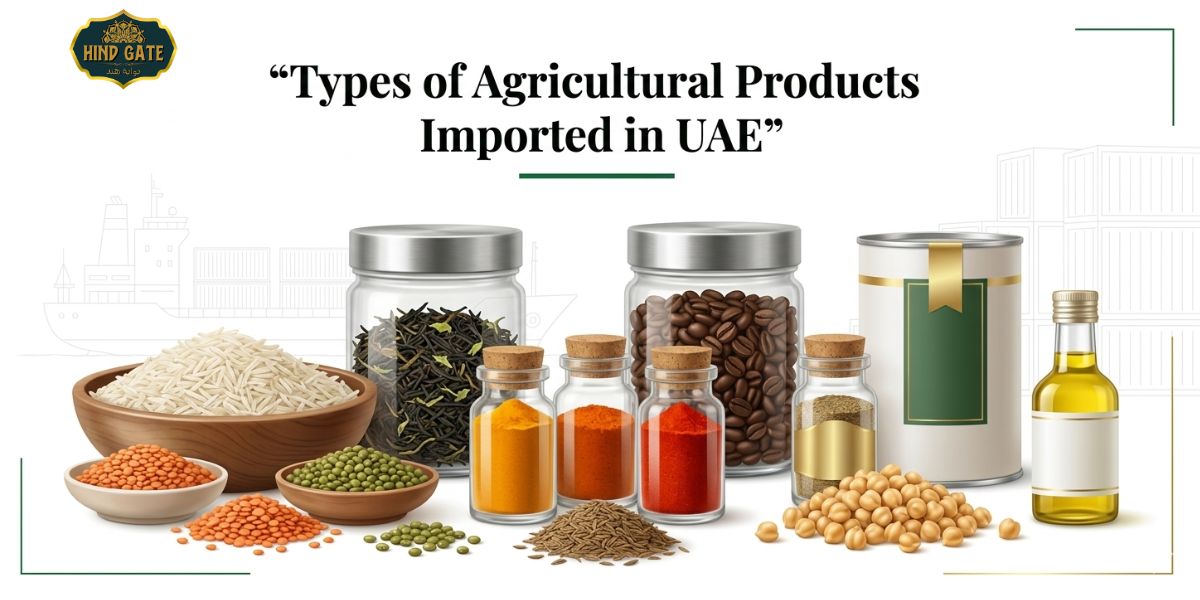
Types of Agricultural Products Imported in UAE
The UAE imports a wide variety of agricultural commodities to meet different consumer needs. Understanding these categories helps exporters align their product offerings with market demand.
Rice and Grains
Rice is one of the most imported staple foods in the UAE. Premium basmati rice, non-basmati varieties, and specialty grains are widely consumed. Exporters often benefit from understanding different types of rice in India to match buyer preferences in retail and bulk segments.
Tea and Coffee
Tea and coffee are essential beverages in the UAE market. There is strong demand for both premium and bulk varieties. Exporters involved in tea export from India and coffee export from India often find steady demand from wholesalers and retail chains.
Spices
Spices are a key part of Middle Eastern and South Asian cuisine. Products such as turmeric, cumin, coriander, and chili are imported in large volumes. Businesses engaged in export spices from India can tap into this consistent demand.
Pulses and Oilseeds
Lentils, chickpeas, and edible oils are also imported in bulk. These products are widely used in households and foodservice industries.
UAE Agricultural Import Trends (2026 Market Insights)
The UAE agricultural import market is evolving due to changing consumer preferences, global supply conditions, and trade policies. Understanding these trends helps exporters align their strategies with current demand.
There is a growing shift toward premium and value-added food products, with consumers preferring branded, organic, and high-quality goods. Additionally, demand for staple commodities such as rice, pulses, and wheat remains strong due to population growth and food security needs. Exporters involved in export rice from India continue to benefit from this steady demand.
Furthermore, the UAE’s role as a re-export hub is expanding, allowing importers to distribute products across Africa and the Middle East. Exporters who stay updated with pricing, quality standards, and logistics can gain a competitive advantage.
Major Agricultural Imports in UAE (Category Overview)
| Product Category | Key Products | Demand Level | Main Use |
|---|---|---|---|
| Rice and Grains | Basmati, Non-Basmati | Very High | Household and HoReCa |
| Tea and Coffee | Black Tea, Green Tea, Coffee Beans | High | Retail and Cafes |
| Spices | Turmeric, Cumin, Chili | High | Food Industry |
| Pulses | Lentils, Chickpeas | Medium-High | Daily Consumption |
| Oilseeds | Edible Oils | Medium | Cooking and Processing |
This table provides a clear overview of high-demand agricultural products in the UAE market. Exporters targeting segments like rice importers in Dubai and spice importers in dubai can use this data to prioritize product categories and improve market entry strategies.
Categories of Agricultural Importers in UAE
Instead of focusing on individual company names, it is more useful to understand the types of importers operating in the UAE market.
1. Large Food Distribution Companies
These companies supply supermarkets, hypermarkets, and retail chains. They import large volumes and prefer long-term contracts with reliable exporters.
2. Commodity Traders
Commodity traders deal in bulk shipments of rice, grains, and spices. Many rice importers in dubai operate in this segment, handling large-scale international trade.
3. Retail Chain Suppliers
These importers focus on packaged goods for supermarkets. They often require branded or private-label products.
4. HoReCa Suppliers
Hotels, restaurants, and catering companies rely on specialized suppliers for consistent quality and timely delivery.
Similarly, spice importers in dubai play a key role in supplying both retail and foodservice markets.
Role of Dubai in Agricultural Imports
Dubai is the center of agricultural trade in the UAE. With world-class infrastructure, free zones, and advanced logistics facilities, the city enables smooth import and re-export operations.
Jebel Ali Port, one of the largest ports in the region, handles a significant portion of food imports. This makes importers in dubai uae highly influential in shaping regional trade flows.
Additionally, Dubai’s connectivity to global markets allows exporters to access not just the UAE but also neighboring countries through a single distribution hub.
How Exporters Can Enter the UAE Market?
Entering the UAE agricultural import market requires a structured approach. Exporters should focus on the following steps:
Market Research
Understand demand trends, pricing, and consumer preferences.
Identify Reliable Buyers
Connect with distributors, traders, and wholesalers through B2B platforms and trade events.
Product Selection
Choose products based on demand, such as rice, tea, or spices.
Compliance and Certification
Ensure products meet UAE food safety standards and labeling requirements.
Logistics Planning
Work with experienced freight partners to ensure timely delivery.
Exporters already engaged in exporting tea from india often find it easier to expand into the UAE due to established supply chains.
Documents Required for Export to UAE
To ensure smooth trade operations, exporters must prepare accurate documentation. Common requirements include:
- Commercial invoice
- Packing list
- Certificate of origin
- Phytosanitary certificate
- Bill of lading
- Halal certification (for food products)
Proper documentation reduces the risk of delays and ensures compliance with UAE import regulations.
Challenges in UAE Agricultural Import Market
While the UAE offers strong opportunities, exporters may face certain challenges.
Price Competition
The market is highly competitive, with suppliers from multiple countries.
Quality Standards
Importers expect consistent quality and adherence to specifications.
Regulatory Compliance
Strict food safety and labeling rules must be followed.
Logistics Costs
Freight and shipping costs can impact profitability.
However, exporters who maintain quality and reliability can overcome these challenges and build long-term partnerships.
Opportunities for Exporters
Despite competition, the UAE market offers several growth opportunities.
- Increasing population and food demand
- Rising preference for premium and organic products
- Strong retail and supermarket expansion
- High demand for ethnic and international foods
Exporters who understand global trade trends, such as those highlighted in the top 10 tea exporting countries, can better position themselves in the market.
Similarly, businesses working with the top 10 rice importers in Dubai often gain access to large-scale distribution networks and repeat orders.
Why Choose Hind Gate General Trading LLC for Agricultural Trade?
Hind Gate General Trading LLC is a trusted partner for sourcing and supplying agricultural commodities in the UAE. With strong connections across global markets, the company supports importers and exporters with reliable trade solutions.
Key advantages include:
- Access to premium-quality rice, tea, and spices
- Strong sourcing network across India and international markets
- Competitive pricing for bulk and wholesale buyers
- Efficient logistics and timely delivery
- Expertise in handling global agri-commodity trade
Moreover, the company’s presence in Dubai enables smooth coordination between suppliers and buyers, ensuring consistent supply and long-term business growth.
Conclusion
The UAE continues to be one of the most attractive markets for agricultural product imports, driven by strong demand, global connectivity, and a growing population. For exporters, understanding the structure of the market, identifying the right buyers, and maintaining quality standards are key to success.
By aligning product offerings with demand and building reliable supply chains, businesses can establish a strong presence in the UAE. Whether dealing in rice, tea, spices, or other commodities, exporters who focus on consistency, compliance, and long-term partnerships can achieve sustainable growth in this competitive market.
For businesses looking to expand in the UAE, partnering with experienced trade companies can simplify the process and unlock new opportunities in global agricultural trade.
Looking for Trusted Agricultural Product Suppliers in the UAE?
Partner with Hind Gate General Trading LLC for reliable sourcing of rice, tea, spices, and agri commodities with competitive pricing and seamless UAE distribution.