


Why Dubai is Becoming the Global Hub for Agricultural Commodity Trade?
Dubai has rapidly emerged as one of the most influential centers for agricultural commodity trade worldwide. From rice, tea, and coffee to spices and pulses, the city plays a crucial role in connecting producers with global markets. Thanks to its strategic location, advanced logistics infrastructure, and business-friendly trade policies, Dubai is now widely recognized as a leading agri trade hub in the Middle East.
For exporters, importers, and commodity traders, understanding why Dubai dominates the agricultural trade ecosystem is essential for long-term growth. This article explains how Dubai became a global agri-commodity hub, the key products traded through the UAE, and why international buyers increasingly rely on Dubai for sourcing and redistribution.
Dubai’s Strategic Location: The Foundation of Global Trade
One of Dubai’s strongest advantages is its geographic positioning. Located between Asia, Africa, and Europe, Dubai offers direct access to some of the world’s fastest-growing consumer markets. As a result, exporters from countries such as India, Vietnam, Kenya, and Sri Lanka view Dubai as a natural gateway for international distribution.
Moreover, shorter transit times and reduced shipping costs make Dubai especially attractive for agricultural commodities that require efficient handling and timely delivery. This strategic benefit has helped the UAE become a preferred destination for food imports into the UAE and global re-export operations.
World-Class Ports and Logistics Infrastructure
Dubai’s rise as a commodity trading powerhouse would not be possible without its advanced logistics ecosystem. Jebel Ali Port, one of the largest ports globally, handles millions of containers annually and supports bulk, containerized, and value-added agricultural shipments.
Key infrastructure advantages include:
- Modern warehousing and cold storage facilities
- Efficient customs clearance systems
- Strong connectivity by sea, air, and land
- Dedicated free zones for food and agri products
Because of this robust infrastructure, agricultural goods move quickly while maintaining quality. Consequently, Dubai has become a preferred hub for large-volume and multi-origin commodity trade.
Dubai as a Re-Export Hub for Agricultural Commodities
Dubai is not just a consumption market, it is a powerful re-export hub. Large volumes of agricultural products are imported into the UAE, stored, repackaged, or processed, and then redistributed to Africa, the GCC, Central Asia, and Europe.
In particular, rice importers in Dubai play a critical role in redistributing Indian and Asian rice to neighboring regions. Similarly, tea and coffee traders use Dubai as a consolidation and redistribution point. This re-export model allows businesses to serve multiple markets efficiently from a single location.
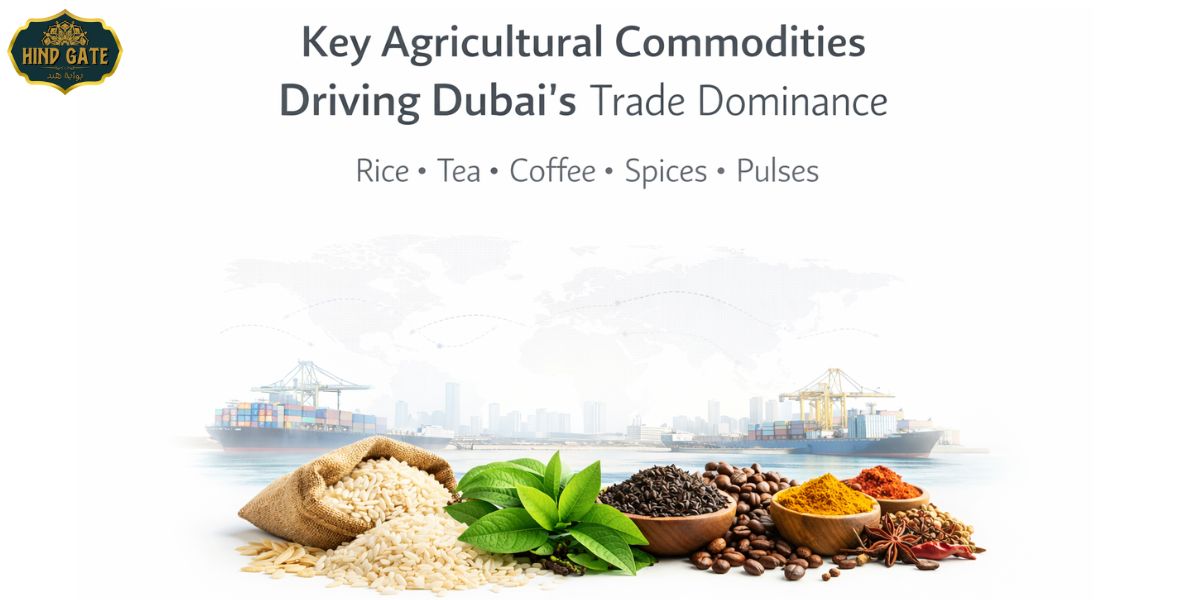
Key Agricultural Commodities Driving Dubai’s Trade Dominance
Dubai’s agri trade ecosystem is built around a few high-demand commodities that move in large volumes through the UAE. These products support both domestic consumption and international re-export markets.
Overview of Major Agricultural Commodities Traded Through Dubai
| Commodity | Major Exporting Countries | Dubai’s Trade Role | Key Import Markets |
|---|---|---|---|
| Rice | India, Thailand, Vietnam | Import, storage & re-export | Middle East, Africa |
| Tea | India, Kenya, Sri Lanka, China | Bulk trade & redistribution | UAE, Europe, Africa |
| Coffee | India, Brazil, Vietnam | Regional distribution hub | GCC, Africa |
| Spices | India, Vietnam, Indonesia | Sourcing, blending & re-export | Middle East, Europe |
| Pulses & Grains | India, Canada, Australia | Bulk commodity trading | UAE, Asia, Africa |
This diversified commodity flow strengthens Dubai’s position as a multi-product agri trading hub rather than a single-commodity market.
Rice Trade Through Dubai
Rice remains one of the most traded agricultural commodities in Dubai. The UAE imports large quantities of rice from India, Thailand, and Vietnam, with Indian rice holding a dominant share.
India’s competitive advantage lies in its variety and scale. Buyers sourcing through Dubai gain access to multiple types of rice in India, including basmati, non-basmati, parboiled, and broken rice. As a result, businesses involved in exporting rice from India often use Dubai as a strategic distribution point for Africa and the Middle East.
Tea Trade in Dubai
Dubai has also become a key hub in the global tea supply chain. Bulk tea shipments arrive from countries ranked among the top 10 tea exporting countries, including India, Kenya, Sri Lanka, and China.
Additionally, companies focused on export tea from India benefit from Dubai’s re-export capabilities, packaging services, and brand-neutral trading environment. This makes Dubai especially important for both bulk tea and value-added tea products.
Coffee Trade and Rising Regional Demand
Coffee consumption across the Middle East has grown steadily, strengthening Dubai’s role in regional coffee trade. India, Brazil, and Vietnam are among the major suppliers supporting this demand.
With increasing interest in specialty and bulk coffee, coffee export from India has found reliable market access through Dubai. The city’s logistics and re-export infrastructure allow traders to serve roasters, cafés, and distributors efficiently across the region.
Spices and Other Agricultural Products
Dubai is also a major trading hub for spices, pulses, and oilseeds. Indian and Asian spices are imported in bulk, processed or blended, and re-exported globally. Many spices importers in Dubai manage large-scale sourcing and redistribution operations, reinforcing Dubai’s importance in the global spice trade.
Business-Friendly Trade Policies in the UAE
Another key reason behind Dubai’s agri trade dominance is its business-friendly regulatory environment. The UAE actively supports international trade through transparent and investor-focused policies.
Key advantages include:
- 100% foreign ownership in free zones
- Minimal import duties on many food products
- Fast approvals and clear regulations
- Strong banking and trade finance ecosystem
Free zones such as JAFZA and DMCC provide specialized infrastructure for commodity traders, making Dubai a low-risk and efficient base for agri trade.
Dubai’s Role in Connecting Indian Agri Exports to the World
India is one of the world’s largest exporters of agricultural commodities, including rice, tea, coffee, and spices. Dubai acts as a strategic bridge between Indian exporters and buyers across the Middle East, Africa, and Europe.
Whether it involves export rice from India, tea shipments, or coffee consignments, Dubai offers logistics efficiency, compliance support, and global market access. As a result, Indo-UAE agri trade continues to grow steadily.
Future Outlook: Dubai’s Agri Trade Growth Beyond 2026
Looking ahead, Dubai’s importance in agricultural commodity trade is expected to increase further. Rising global food demand, population growth in importing regions, and improvements in supply-chain technology will continue to drive volumes.
In addition, sustainability, traceability, and quality assurance are becoming critical factors in agri trade. Dubai’s advanced infrastructure and regulatory systems position it well to meet these evolving requirements.
Conclusion
Dubai’s transformation into a global agricultural commodity hub is driven by its strategic location, world-class infrastructure, and trader-friendly policies. From rice and tea to coffee and spices, the city efficiently connects producers with international markets.
Understanding Dubai’s role in agri trade helps importers, exporters, and traders make informed sourcing decisions and expand their global reach. As international food trade continues to grow, Dubai is set to remain a central pillar of the global agricultural supply chain.
For businesses involved in rice, tea, coffee, or spices, leveraging Dubai’s agri trade ecosystem offers long-term opportunities for sustainable growth and global market expansion.
Ready to Source Reliable Basmati Rice?
Whether you are a retailer, restaurant, or bulk buyer, Hind Gate General Trading LLC ensures premium basmati rice, reliable supply, and competitive pricing connect now to source with confidence!